
Protocol Feasibility.
Built on Real-World Demand

Quantify enrollment risk before launch with real patients—
not assumptions.


Built on patient acquisition systems used across multiple therapeutic areas to support clinical trial recruitment.
The Problem

Traditional feasibility relies on estimates. Enrollment does not.

The "Incentive" Gap

Investigators are incentivized to be optimistic to win the study. CROs are incentivized to be optimistic to win the bid. This creates a "Hope-Based" model where everyone agrees on an estimate that has never been tested against a live patient.

The "Historical" Trap

Most feasibility reports are "look-backs"—historical data from patients who were treated years ago under different standard-of-care conditions. They don't account for the patient sitting in a doctor's office today who is already on a prohibited medication.

The "Unseen" Bottleneck

You can estimate site capacity, but you can't know the Screen-Fail Rate of a draft protocol until it hits the real world...after losing months of runway

Estimates are free. Delays cost millions.

About Image
The Solution

The Live Feasibility Stress Test

De-risk your trials via real-time feasibility signals generated before the first site is activated.

We measure real patient interest & eligibility against proposed inclusion/exclusion criteria — prior to study launch.

Verified Signals

We don’t ask investigators if they can find patients—we find them ourselves. Our data is independent of site optimism and CRO bidding pressure. You get an unvarnished, third-party audit of your protocol’s "enroll-ability" based on actual patient response, not a doctor’s best guess.

Live-Pulse Data

History is a poor predictor of current recruitment. Our Stress Test captures the real-world comorbidities and medication profiles of patients in the digital landscape today. We identify the disqualifying beta-blocker or the slightly-too-high BMI, in real-time.

Quantified Clarity

We don’t just flag risks; we quantify the screen-fail. We provide the percentage drop-off for every I/E criteria. This allows the CMO to see exactly which "scientific" requirement is acting as a "recruitment" anchor, providing the data needed to optimize before the first site is ever activated.

Financial Impact

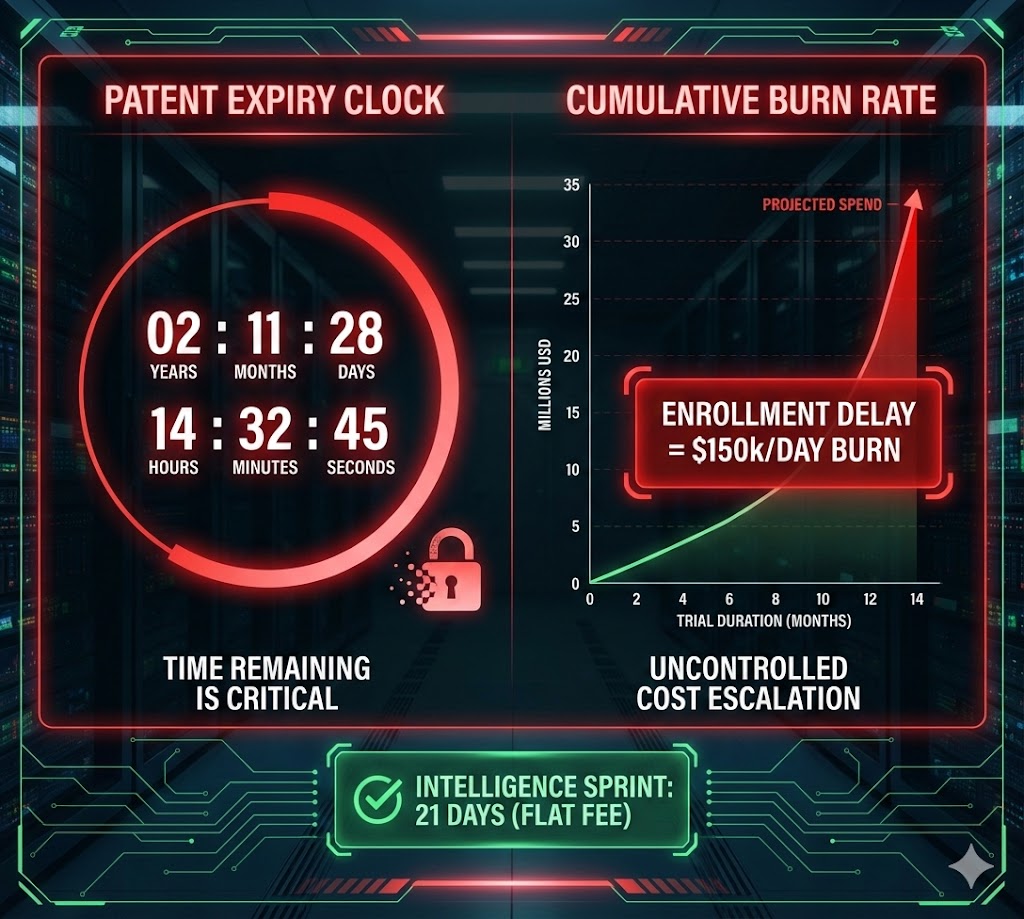
The "Cost of Silence"


$535,000
per Protocol Amendment

Months of enrollment delays

20-30%
Protocol Failure Rates

$??MM in lost Patent Life
About Image
How we work

The Process

Discovery to delivery, we follow a proven framework that ensures clarity, precision, and growth.


Process Image
01
Day 1-3 Discover & Define
Goal Definition & Alignment
Protocol Ingestion
Digital Funnel Setup
Site Specific Geofencing (Optional)
Process Image
02
Day 4-17

Live Patient Sourcing &
I/E "Stress Testing"
Real-time sourcing via online channels
I/E criteria presented in patient-facing language
Initial Insights
Process Image
03
Day 18-20
Data Synthesis
Screenfail modeling
Recommendations
Process Image
04
Day 21
Intelligence Briefing
Final Report
Joint Stakeholder Meetings

Frequently asked questions

Answers to common questions about our platform and services.

We already do feasibility, how is this different?

Traditional feasibility is retrospective, relying on PI estimates, epidemiology modeling, or historical enrollment data. Our offering is prospective and live,  based on actual observed patient interest against proposed eligibility criteria.

Why invest before a trial even starts?

Think of it as cost effective "Amendment Insurance" or "Enrollment Insurance". If our intelligence prevents just one major amendment or shaves one month off your enrollment timeline, the ROI is upwards of 5x. We help you move from "Panic-Amending" to "Pre-Optimizing."

Is this Patient Recruitment?

No. Although there is some overlap in methodology, the purpose of Protocol Feasibility is to identify potential eligibility friction, test screen fail assumptions, and surface potential costs and challenges early enough to make them actionable.

How long does it take? We have very tight timelines.

We can produce signals in weeks, rather than months. Our methodology is designed for "parallel pathing".  Our sprint is executed while your medical and regulatory teams are performing their final internal reviews of the draft protocol. By the time you are ready to "lock" the protocol, you have our Drop-off Map in hand, allowing you to make data-driven adjustments before submission, rather than pausing for a protocol amendment six months later.

Can your data actually change the scientific design of the protocol?

We focus on the "Operational-Scientific Gap." While we don't dictate your primary endpoints, we provide the evidence needed to challenge "Nice-to-Have" exclusions that are "Must-Haves" for recruitment. For example, if your scientist wants to exclude patients on beta-blockers, but our data shows that excludes 75% of the target population, we provide the CMO with the statistical ammunition to move that criteria from "Absolute" to "Controlled," saving the trial's timeline without compromising safety.

What if my trial is already live, but enrollment has stalled? Is it too late?

It is never too late for Rescue Feasibility. If your enrollment is flatlining, we can run a "Diagnostic Stress Test" on your current protocol to identify exactly which criteria are causing the bottleneck. This provides the CMO with the definitive evidence needed to justify a Protocol Amendment to the Board, turning a "failed" trial into a successful one with surgical precision.

What if we can't change the protocol? Is this a waste?

Even when protocol revisions aren't an option, our intelligence replaces "guesswork" with operational predictability. If the data reveals a high-friction enrollment environment, Clinical Operations can proactively scale their site footprint, trigger "rescue sites" before the lag occurs, and right-size the budget for intensive patient identification. It’s the difference between a planned expansion and an emergency intervention.

Stop Guessing.
Start Knowing...

Cta Image